This post was written by Makayla Bowman (‘26) and Clementine Worshek (‘28), Special Collections & University Archives Student Aides, in Fall of 2025.
April 23rd, 2026, will mark the 100th Devil-Goat Day in the University of Mary Washington’s history. For those unfamiliar with this particular school tradition, Devil-Goat Day is hosted on the afternoon of the last Thursday of classes each spring semester. Students graduating in an even year are called Goats, and their primary color is green. Students graduating in an odd year are called Devils, and their primary color is red. On Devil-Goat Day, students don their mascot’s colors and compete in various field games like obstacle courses, riding a mechanical pig, and the infamous Tug-of-War. Though this spring marks the tradition’s centennial anniversary, Devil-Goat Day hasn’t always looked like it does today.
Devil-Goat Day was founded in 1926 by Eileen Kramer Dodd. She was a professor of education and the sponsor of the junior class in her first year as a faculty member. That year, Dodd and members of the junior class decided that they wanted to have their own class mascot, and they chose the symbol of the Goat. After the junior class showcased their new symbol with green, color-coordinated outfits around campus, the seniors decided that they needed to create their own mascot, the Red Devil. From that moment on, the Devil-Goat rivalry was born.
At first, competition between Devils and Goats occurred throughout the entire year, in which Devil-Goat Day marked the last day that the teams could earn points through sports competitions. However, as the school changed from a two-year college to a four-year university, along with becoming co-ed in 1970, Devil-Goat Day changed as well. Even though Devil-Goat Day is currently only celebrated on the afternoon of the last Thursday of classes during each spring semester, the spirit and competition of Devil-Goat Day have persisted longer than any other tradition at the University of Mary Washington.
Over the course of the Fall 2025 semester, two Student Aides in Simpson Library’s Special Collections University Archives (SCUA) were tasked with researching and curating an exhibit about Devil-Goat Day’s momentous anniversary. Makayla Bowman (‘26) and Clementine Worshek (‘28) just finished installing their exhibit, One Hundred Years of Horns: Celebrating the Centennial of Devil-Goat Day, on the second floor of the Simpson Library, to the right side of the entrance to the Special Collections Reading Room.
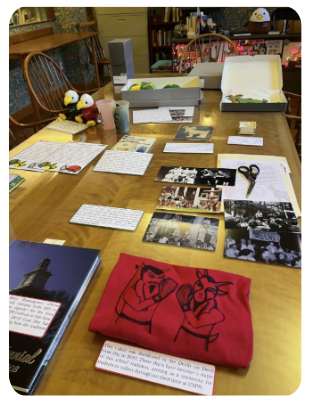
To begin the project, Makayla and Clementine combed through resources offered by the SCUA. To ground themselves in the history of the tradition, the duo read sections of William Crawley’s University of Mary Washington: A Centennial History, 1908-2008. This book largely influenced the creation of the timeline on the exhibit’s bottom shelf. Next, they searched terms like Devil-Goat Day, tradition, and competition in the University of Mary Washington Digital Collections. This website provides access to all digitized materials from the SCUA. Makayla and Clementine looked through past editions of the school’s yearbook, The Battlefield, student handbooks called The Bayonet, and The Bullet, which was the student newspaper that was later renamed to The Weekly Ringer. Further, the duo looked for mentions of Devil-Goat Day in the SCUA’s huge catalogues of photographs, some of which are currently on display in the exhibit.
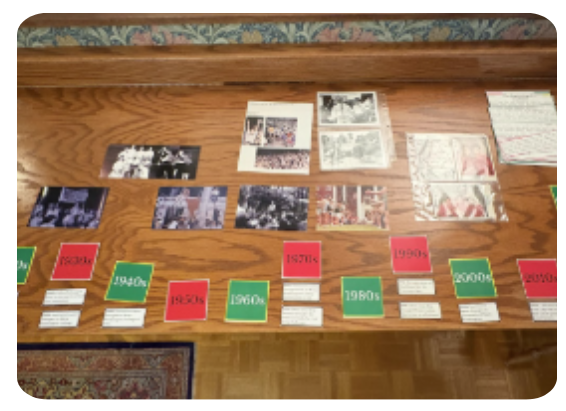
As Clementine and Makayla went through resources, they compiled their findings in a collaborative Google Doc and Google Sheets file. By using a spreadsheet, the two SCUA aides were able to sort through artifacts based on decade, description, and material type, such as photographs, physical objects, and bound volumes. The Doc and Sheets files were instrumental in keeping track of which resources had already been looked over, as well as building upon information to create a fuller picture of what Devil Goat Day looked like over time.
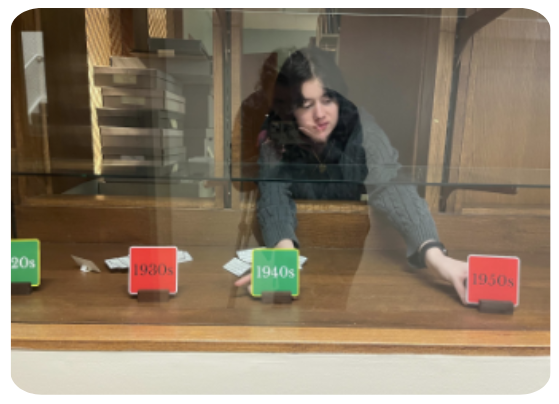
On December 1st, 2025, Makayla and Clementine worked on installing the exhibit, representing the culmination of a semester’s worth of work. First, the duo cut out the labels they had prepared, assembled the photos, and pulled any bound artifacts from the Rare Book Room. Over the course of a few hours, Makayla and Clementine moved the artifacts and labels into the case. The duo worked backwards, in a sense, since the doors to access the exhibit case are on the back side. One Hundred Years of Horns includes bound paper artifacts–like the Battlefield and student handbooks–but the exhibit also includes stuffed plushies, a metal brooch, a t-shirt, and plastic cups, among other artifacts. Displaying such a wide variety of objects proved to be an interesting challenge. Makayla used an archival-safe box and some carefully folded red fabric to help display a Devil brooch on the top shelf. Clementine cleverly clipped a 2007 red Devil shirt onto another box using clips sandwiched with acid-free paper. The 2008 Battlefield yearbook is propped open with two different acrylic stands due to its size and is held open with a strip of clear cellophane.
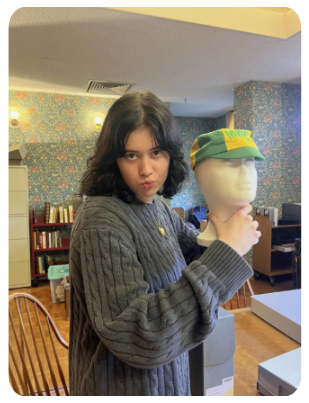
Overall, the exhibit design and installation went off without a hitch. The reds and the greens of the different artifacts make for a pleasant, bright journey through the one-hundred-year history of this beloved school tradition. For a century, Mary Washington students have all bonded over their shared experiences of Devil-Goat Day. If nothing else, Devil-Goat Day is unique in this aspect, as no other tradition has survived this long and has made such a large impact on UMW culture. For Makayla, this spring will mark her last Devil-Goat Day. For Clementine, they have only experienced one Devil-Goat Day so far. These two perspectives–one older Goat and one newer Goat–have one thing in common: a love for a century-old tradition and the fierce sense of competition that Devil-Goat Day brings!
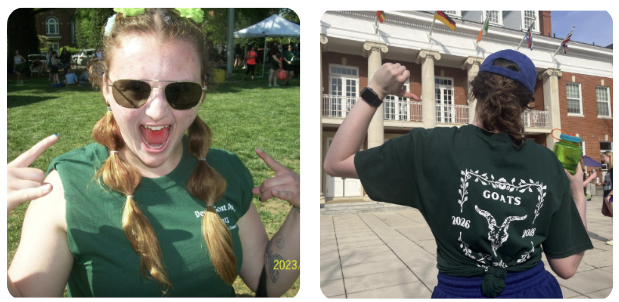
Left: Makayla Bowman (‘26) represents the Goat team with pride during her first Devil-Goat Day on April 20th, 2023. Photo by Nicholas Werderman. Right: Clementine strikes a pose during her first Devil-Goat day on April 24, 2025, proudly showing off that it’s great to be a goat!
“Even before I got on campus, I knew Devil-Goat Day would be my favorite tradition at Mary Wash. I love the competition, the camaraderie, and school spirit that radiates off of students during Devil-Goat Day!” – Makayla Bowman (‘26)
One Hundred Years of Horns will be on display on the second floor of the Simpson Library through May 2025.

Such a neat opportunity for undergraduate research & exhibition design! Thank you, SCUA, for this amazing experience. 🙂
Hey, I worked on this! It was so much fun to dig around for cool Devil Goat Day stuff. Everyone please go check it out it looks so awesome >:D