This post was written by Caitlin Ervin ’28, Special Collections & University Archives Student Worker

Dr. Venus R. Jones: One of the Few, Precursor to Many
This Thursday, March 26th, guest speaker, author and historian Mary Ellen Curtin will present on the legacy of Barbara Jordan as part of the Great Lives lecture series. Jordan was a Texas-born politician, orator, and educator who made history with a number of firsts over the course of her political career: the first Black person elected to the Texas Senate since 1883, the first Black woman ever elected to the Texas Senate, and the first Black Texan ever elected to the U.S. Congress.
In honor of this lecture, Special Collections and University Archives is proud to present a short piece on the career and legacy of Dr. Venus Jones ‘68, an alum who accomplished a number of her own firsts both during and after her time at Mary Washington, leaving a lasting impact on the college.
Career
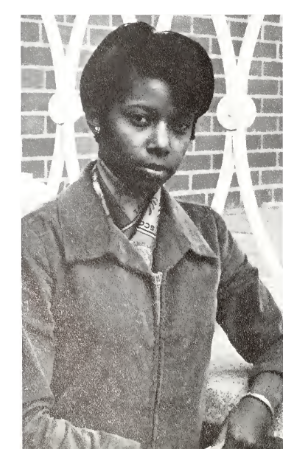
Mary Washington was not Jones’ first choice for college. She had initially applied to the University of Virginia, however, the administration at the time refused to admit a woman to their pre-med program and instead suggested that she apply to its sister school, Mary Washington. Within three years of her admittance, Jones became the first Black graduate from MWC in May 1968 with a Bachelor of Science in Chemistry. She then went on to attend the University of Virginia’s medical program as one of only six women, and the only Black woman. During her time at UVA, she was involved with the Community Health Project, which provided free medical care to the community, while also doing her clinical rotations. She graduated from UVA in 1972 and spent the next few years on the west coast interning with a local indigenous population in Phoenix, Arizona, and completing her medical residency at the Children’s Hospital in San Francisco. She then returned to Virginia to complete an additional three-year residency in neurology at UVA, followed by a fellowship specializing in epilepsy.
After completing her medical training, Dr. Jones enlisted in the U.S. Air Force with the intention of working professionally before opening her own private practice. By 1981, she had become the Chief of Neurology at the Malcolm Grow Medical Center at Andrews Air Force Base in Maryland and was one of only three Air Force neurologists stationed on the east coast. She also served as a consultant to the Surgeon General of the Air Force. She continued her career as Chief of Neurology at two other Air Force hospitals and ultimately retired with the rank of Lieutenant Colonel after serving nearly twenty years. In 1998, she moved to Clarksdale, Mississippi and fulfilled the dream of opening her own clinic, the Delta Neurology Clinic, which she operated until her death on May 17, 2001, at the age of 53.
Commentary on Race at MWC
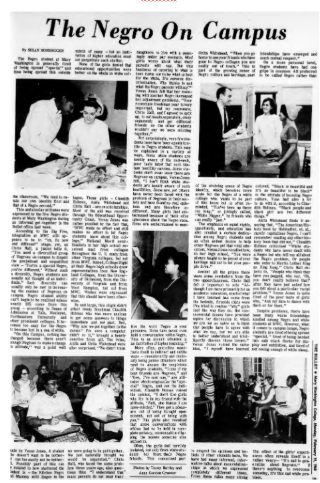
On February 19, 1968, three months before Jones graduated, an article titled “The Negro On Campus” was published in the weekly student newspaper, The Bullet. In the article, Jones, alongside Chris Hall ‘69, Dottie Holmes ‘71, Anita Whitehead ‘71, and Orita Whitehead (known as MWC’s “Big Five”) detailed their experiences as the only Black students on a majority-white campus. In the article, Jones is quoted as saying that “On this Campus, nothing has changed because there aren’t enough Negroes to make a change in attitude.” She also called out MWC for not advertising itself to potential Black students like other colleges had, such as UVA and the University of Richmond. The women viewed this as MWC not taking the issue of integration or potential of Black students seriously.
It was first-year Dottie Holmes who brought up discrepancies in student housing, with she and the Whitehead sisters sharing one dorm room. Jones and Hall had experienced the same when they were freshman roommates in 1965, and the two, while genuinely friends, had to make a point of having different social routines so as to not always be grouped together while living on campus. This issue of equitable housing assignments was not addressed by Chancellor Grellet Simpson until January 1969, nearly a year later.
Legacy
Throughout Dr. Venus Jones’ academic and professional careers, she was constantly one of the few due to her status as Black, a woman, or both in environments that were overwhelming run by white men. In fact, Jones said that while attending medical school at UVA, she faced more adversity for being a woman, than she did for being Black. However, her race was a defining part of her experience at Mary Washington College, which coincided with many other firsts for the school. This includes the first Black residential student, Kay Savage, who attended MWC from 1964-1966, and the first Black faculty member, Johnny P. Johnson, who was a part-time instructor for art education beginning in 1968. While these individuals may not have faced as much blatant racism while on campus as they may have a few decades prior, they still consistently dealt with microaggressions from other students, separation from Black communities, and an administration that was slow-to-react to their needs.
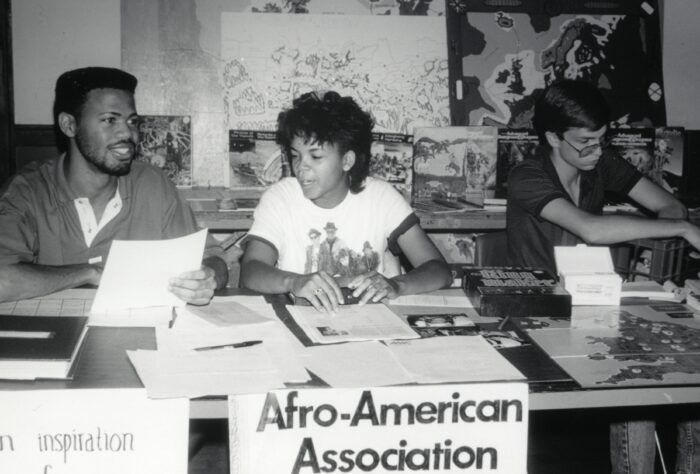
In the nearly 60 years since the publication of the 1968 Bullet article about the Big Five, the Mary Washington campus has intentionally evolved to be more welcoming and inclusive, though not without criticism from students, both Black and white alike. Perhaps the most significant social changes originated with the founding of the Afro-American Association by students. Dottie Holmes ‘71, one of the Big Five, helped establish the Afro-American Association in 1970 and served as its first president. In the early 1970s, the club was a frequent contributor to The Bullet, writing about social and political injustices faced by Black women. They also organized the first Black Culture Week, held in February of each year. Black Culture Week has since expanded into the Black History Month Celebration, now organized by the James Farmer Multicultural Center. In 1987, the Afro-American Association changed its name to the Black Student Association, which it continues as today.
Those interested in the work and legacy of Barbara Jordan should attend the Great Lives lecture by guest speaker Mary Ellen Curtin on her book, She Changed the Nation: Barbara Jordan’s Life and Legacy in Black Politics. It is hosted this Thursday, March 26th, in Dodd Auditorium beginning at 7:30 pm.
Want to learn more about Venus Jones during her time at Mary Washington? You can listen to the Venus Jones Oral History Collection from UMW Special Collections and University Archives’ Digital Collections.
Additional information about Barbara Jordan from Circles: The Buffalo Women’s Journal of Law and Social Policy – HeinOnline.org.

Really great article! Made me do a deep dive into old Bullet issues.