Congratulations to our Class of 2025 SCUA Student Assistant!

After a wonderful 2024-2025 academic year, we extend our heartfelt congratulations to our three outstanding student assistants, Erica (Rickie) Berger, Haley Cotton and Shenandoah Iem, who graduated in May 2025 and are embarking on new adventures.

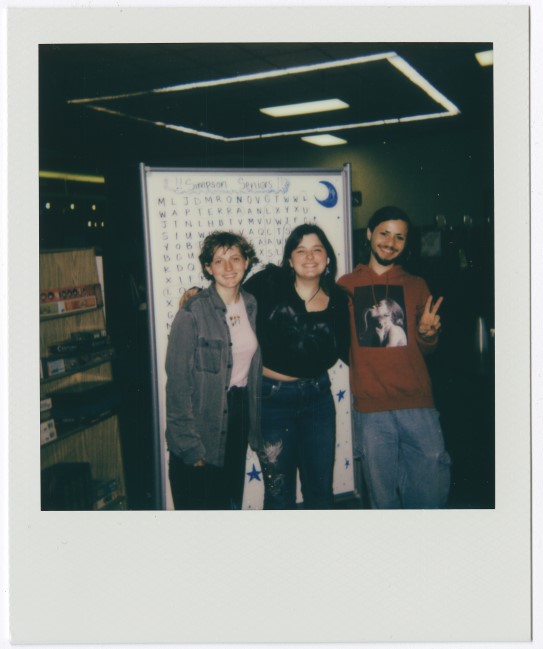
Polaroid of three people standing in front of a whiteboard; the person on the right makes a peace sign, with shelves visible in the background.
From left to right: Rickie Berger, Haley Cotton and Shenandoah Iem at Simpson Library’s Student Banquet.

Rickie Berger‘s passion for archives started as a volunteer position working on our extensive photo processing project. They continued to show their commitment to the field during an internship working with the Mutual Assurance Society Policies collection at the Library of Virginia. Rickie’s dedication culminated in becoming a student assistant and being awarded the 2025 University Librarian Award.

Haley Cotton began as an intern for SCUA and transitioned into a summer assistant role, working on transcription for the Mutual Assurance Society Policies. Haley is our go-to person for research projects and has digitized a significant number of alumni photos – a well-loved and important collection that we are excited to have scanned.

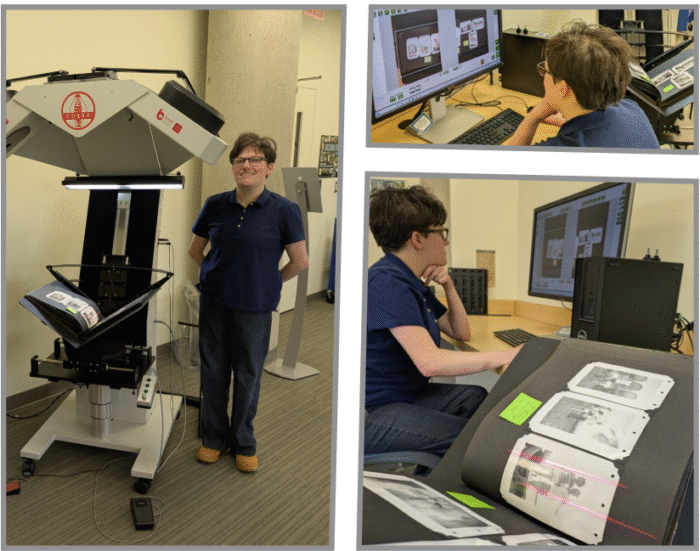
Shenandoah Iem began as a summer student assistant and continued to work with us throughout the academic year. Shenandoah has contributed to multiple projects, including a special preservation project for the Dahlgren Heritage Museum and the Mutual Assurance Society Policies digital collection. Shenandoah has become one of our most proficient staff members in operating the Cobra Book Scanner.

This is a bittersweet farewell, as all our students have demonstrated their passion and skills within Special Collections & University Archives, and they will be greatly missed. We look forward to seeing the incredible things these students will achieve post-UMW.

A Glimpse into Rickie Berger’s Journey: An Optional Graduating Senior Interview with SCUA

What brought you to work in Special Collections & University Archives?

RB: I plan on pursuing a master’s degree in library science and to work in archives one day. I have really appreciated the opportunity to gain practical experience in this field from the Special Collections & University Archives. 

What was your favorite project that you worked on during your time as a Special Collections & University Archives Student Aide?

RB: I’ve enjoyed preparing the Mutual Assurance Society insurance policies to be available digitally. This project has been an extension of my summer internship with the Mutual Assurance Society and the Library of Virginia. I’ve had the opportunity to work on a variety of aspects of this project, which has given me a holistic perspective on the management of digital collections. 

Person with short curly hair reviewing documents from an archival box at a desk in an office.
Rickie Berger using archival recourses

What is your favorite item (or collection of items) in UMW Archives and why?

RB: I love the scrapbook collection, particularly the scrapbooks from the early 1900s. The inclusion of a variety of materials in these scrapbooks, such as locks of hair, make them very unique.

What is your favorite rare book from the rare book collection and why?

RB: I love the copy of The Vindication of the Rights of Women by Mary Wollstonecraft, because I have always been fascinated by Wollstonecraft’s work. 

What are your post-Mary Washington plans?

RB: I plan to take a year to work before returning to graduate school to pursue a MLIS. 

What kinds of archival resources do you think researchers will use in the future when looking back at what Mary Washington was like in 2025?

RB: I think future researchers will look at materials related to student organizations, since they are very emblematic of campus life. Many of those materials will likely take the form of photographs and social media posts, since that is the main way information is saved and shared currently.  

Do you have any favorite Mary Washington memories?

RB: My favorite thing about UMW is the people I have met. I’ve been fortunate enough to befriend awesome people here who have shaped my college experiences.  

Special Collections & University Archives Internship Spring 2025

This post was written by Katie Connor ’25, Special Collections & University Archives Intern, in April 2025.

This spring, I spent my Monday, Tuesday, and Thursday afternoons interning in UMW’s Special Collections and Archives. I’ll be graduating this May, and while it’s bittersweet to be saying goodbye, I’m incredibly grateful to have ended my college career on such a high note. I found this internship to be a fantastic introduction to the world of rare books and the work of an archivist. I’m leaving with a solid foundation in archiving, stronger skills in writing and technology, and a much clearer idea of the career paths available to me.

I spent the first half of the semester developing sub-collections of UMW’s rare books. While we’ve had a rare book collection since 1964, there hasn’t been an easy way to browse our holdings. This project made our collection more accessible by organizing it into easily browsable categories, sorting books by genre, period, and author. I began by getting to know the rare books room, looking for items that might be of interest to students. Once I had a sense of the collection’s highlights, I researched authors, titles, and editions to build thematic groupings. For example, when I discovered we had works by Eliot and Pound, I started looking for other modernist poets in our collection and found quite a few! After developing the sub-collections, I photographed book covers using the Cobra Scanner and helped build an online database through Alma, which gave me valuable experience with the technical side of library work.

 The site should be live by the end of the semester. It was a really exciting way to use what I’ve learned as an English major while also developing my digital skillset and learning about book history. Our hope is that the project will make the rare books collection less intimidating and more useful for students and faculty. This project is ongoing, with more sub-collections to be added by Special Collections staff and students.

In the second half of the semester, I created an FAQ guide for researchers interested in UMW’s history. The archives receive many similar research requests, and this guide is meant to make common topics of interest accessible. I spent a lot of time digging through issues of UMW’s student newspaper, as well as scrapbooks, photographs, and institutional records. It was a great introduction to archival research and gave me a lot of practice writing clear and engaging text for a public audience. Once the research was complete, I designed the site itself using LibGuides. This process taught me how to present information in a way that’s easy to navigate and digest. Working on this guide gave me a deeper appreciation of UMW’s history and helped me feel even more connected to campus. It was a special way to finish my undergraduate years, and I hope the guide helps future researchers and community members feel that same connection.

Beyond my two main projects, I got to do a little bit of everything that makes up the day-to-day work of the UMW Archives. I helped with scanning requests, researched our periodical collections, and even spent a day looking through old atlases in search of sea monsters. The archives staff made an effort to include me in their work, and I always felt supported and encouraged to explore new opportunities and challenges.

One of my goals going into this internship was to find a bit of clarity about what I might want to pursue as a career, and I can confidently say my experience at UMW’s archives gave me just that. This internship was an amazing learning experience, and Regan, Sarah, and Angie were fantastic teachers. My time in Special Collections deepened my appreciation for archival work, helped me see new possibilities for my future, and made me feel more connected to UMW than I have before.

Special Collections Internship Spring 2025

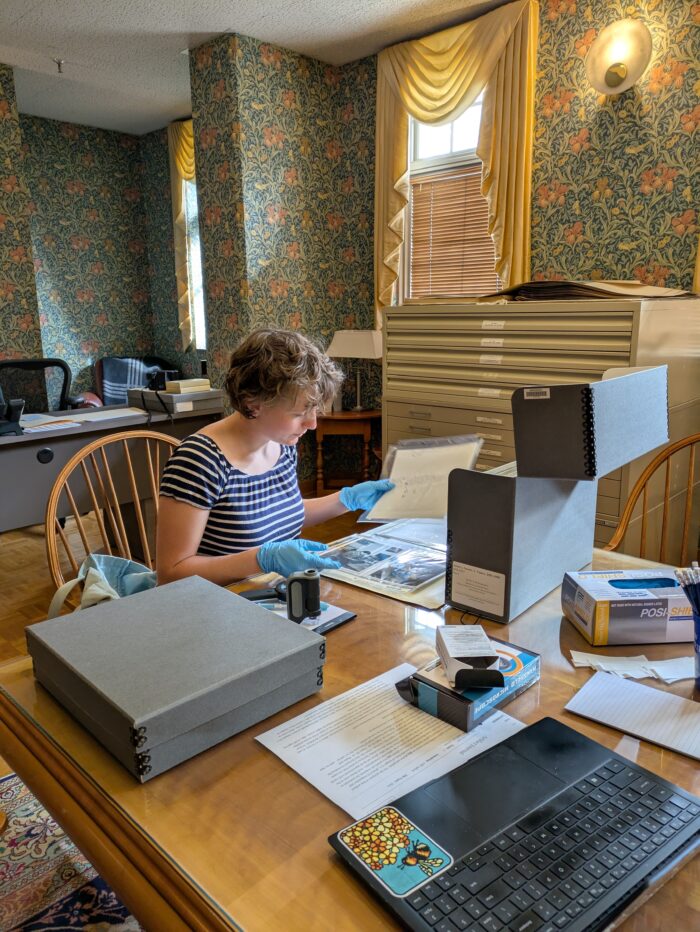
This post was written by Emma Galvin ’25, Special Collections & University Archives Intern, in May 2025.

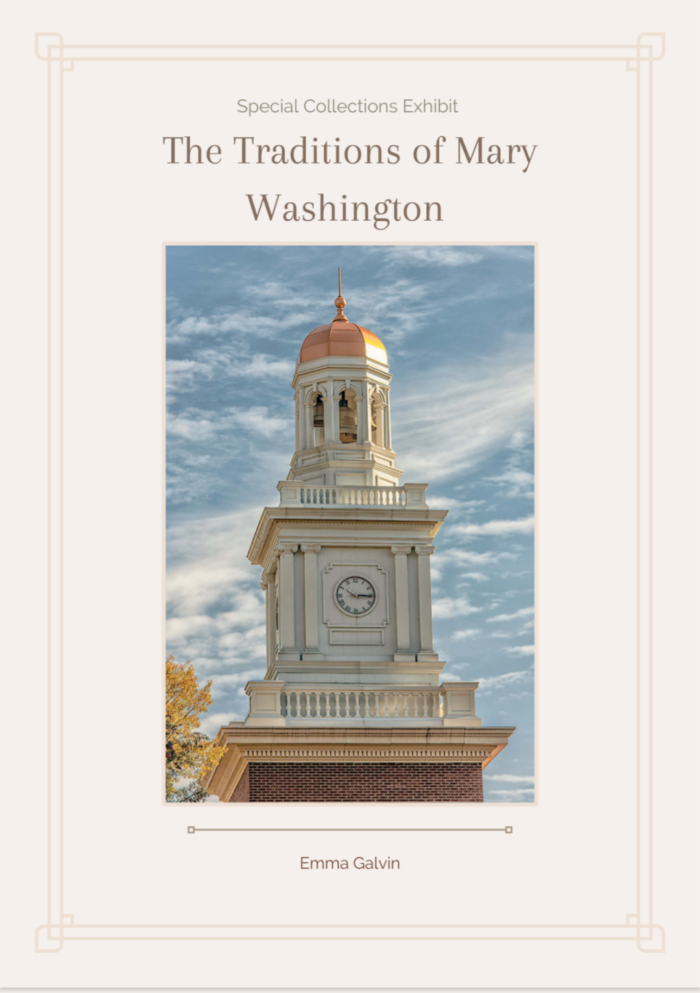
Cover titled ‘The Traditions of Mary Washington’ featuring a photo of the UMW clock tower against a blue sky.

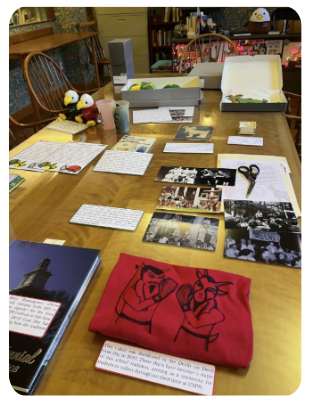
During the 2025 spring semester at the University of Mary Washington, I had the opportunity to work with Special Collections at Simpson library on campus. The goal of this internship was to not only complete the academic requirement for the museum studies minor, but for me to learn what it takes to work with collections, artifacts, and learn the in and outs of exhibit planning. By the end of this internship, the objective was for me to create an exhibit within the library based on the artifacts special collections had in their inventory.

One of the first things I did while here was watch a few webinars on what scrapbooks were, the process on conserving and preserving them, the proper storage care, what they can potentially tell us about the time they were made, as well as some of the copyright issues that might pop up with scrapbooks. Preserving scrapbooks can be fairly tricky due to the various types of objects that are put into scrapbooks and how those objects are affixed to the pages. Scrapbooks aren’t made with longevity in mind. Its pieces of paper and mementoes of all sorts glued into a book. Not only does the paper get more fragile as time goes on, but the glue does as well leaving many of the objects prone to falling off or out of the scrapbook. Due to the different materialities of objects displayed, there isn’t often one preservation method needed when preserving these books. I had to keep this in mind when I was going through the scrapbooks they had in their collection.

After learning about scrapbooks, I could finally start going through them. I needed to familiarize myself with the content of the books to try and come up with an exhibit topic. This meant going through 20+ scrapbooks and taking notes of what I found in the pages. These scrapbooks were mostly from former alumni who scrapbooked their time at the college. The scrapbooks I looked at started as early as 1917 and went through the late 1950s. When going through them, I started noticing how many traditions, clubs and events that were highlighted over this 40 year period. Most of what I found were campus traditions that were started by students and staff. The four that were mentioned the most were May Day, the Daisy Chain Ceremony, Peanut Week, and Devil-Goat Day. All of these traditions have long since ended, except for Devil-Goat Day which still occurs to this day.

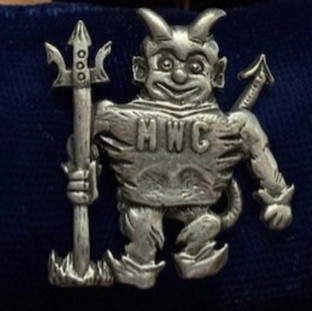
Sliver devil brooch with the letters MWC on its chest.

To further understand what these traditions were, I read through two books. The first called History of Mary Washington College 1908-1972 written by Edward Alvey Jr. and the second being University of Mary Washington: A Centennial History 1908-2008 written by William B. Crawley Jr. Through looking at the information these books provided, as well as going through past UMW yearbooks, and using letters and information from the scrapbooks themselves, I had enough information to write the introduction labels for each tradition. After this, I started making a list of all the objects I would like to put on display. During my research, I found many photographs depicting the various traditions within Special Collection’s digital repository. I also found yearbooks with good images and quotes to display, as well some actual artifacts that could be displayed. Items such as felt goats made for Devil-Goat Day in the 1930s, and decades worth of May Day programs.

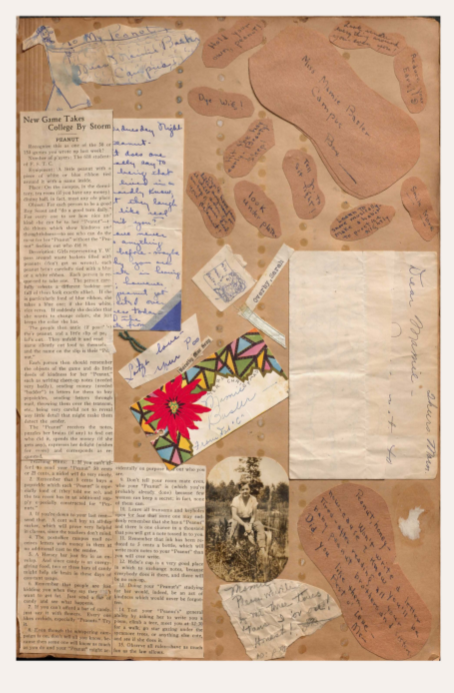
The scrapbooks had valuable objects to display as well. The issue with these artifacts is that most of them were affixed to the books themselves. Due to the fragility of most of these scrapbooks, they weren’t suitable to be displayed open. Instead, I scanned in the pages of the objects I wanted to display, printed them out, and then showcased them next to their respective scrapbooks.

Scrapbook page with newspaper clippings, colorful handwritten notes, a geometric flower design, and a black‑and‑white photo of a person outdoors.”

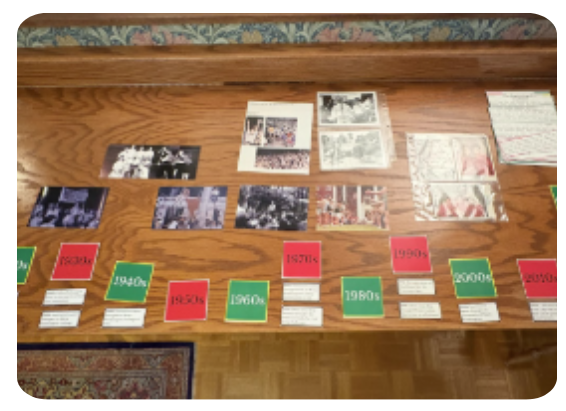
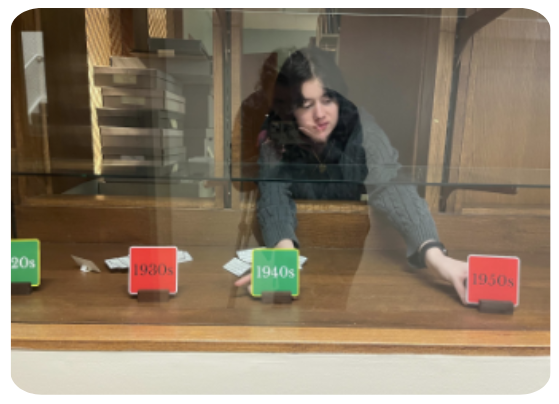
Finally it was time to set up the display. After printing out the photos and cutting out the objects labels I spent a couple weeks writing, I had enough to start planning the layout. Initially, to get a general sense of spacing in the two display cases I could use, I decided to only set up with the photos, labels and placeholder items. Those included stands I planned on putting artifacts on as well as picture frames roughly the size of the items I planned on displaying. This helped me realize that some sections of my display were spaced perfectly, some had too many items, and some spots needed additional artifacts to fill up the space. To plan that out, I used an editing tool on my phone to draw in where I think objects should go. This helped me rework the initial plan I had for the exhibit into a layout that would actually work. Since the tradition of May Day went on for so long, I could fill up one entire display with information on just that tradition alone. Because of that, and the comparatively less information on the traditions of Peanut Week and the Daisy Chain Ceremony, I figured out I could fit those traditions along with Devil-Goat Day in the other display case. I spent a couple of weeks setting up the display and figuring out the display props I could use to safely prop up some of the items. There were a few weirdly shaped objects, such as two felt goats I decided to display, that took some brainstorming to figure out the best way to safely prop them up and make them visible without ruining or harming the integrity of the object. Overall, this semester was a great experience and I learned a lot about the ins and outs of label writing, exhibit planning, and working with existing collections to try and come up with a meaningful narrative to display.

Read more about “The traditions of Mary Washington” by clicking this link to the catalog or visiting the exhibit displayed in the Special Collections and University Archives case from spring to fall 2025 on the 2nd floor of Simpson Library.

Exploring History Through Books and Digital Collections: A Special Collections & Archives Internship

This post was written by Natalia Ramirez ’25, Special Collections & University Archives Intern, in April 2025.

This semester, I have embraced the exciting opportunity to once again intern at the University of Mary Washington’s Special Collections and Archives, after a phenomenal experience with my internship last Fall semester. Here, I have been gaining hands-on experience in rare book appraisal and digital curation. As an Art History major on the brink of graduation, this internship has offered me the opportunity to blend my passion for historical artifacts with the evolving field of digital humanities.

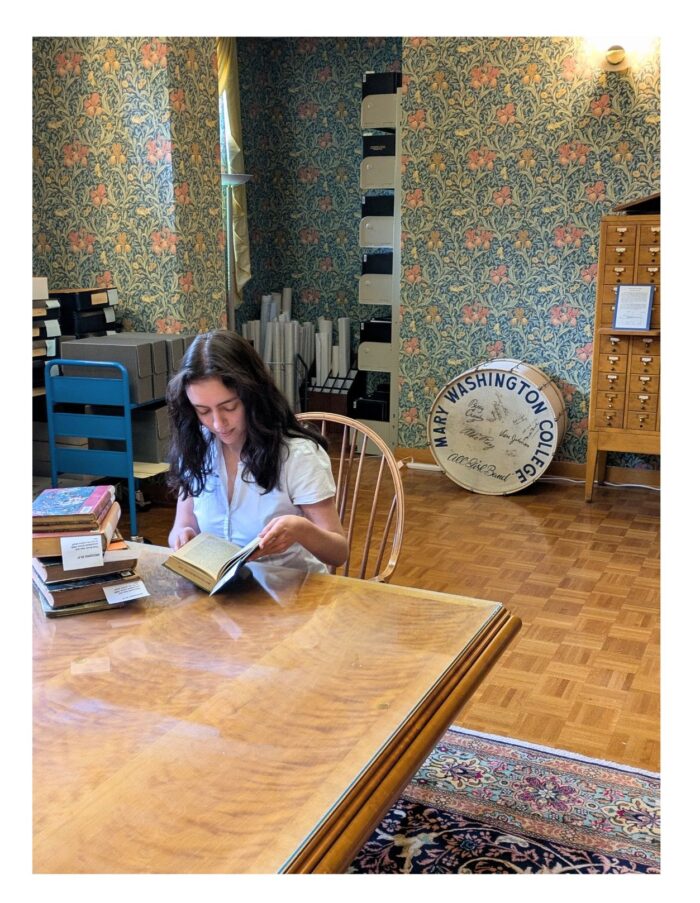
Person reading at a wooden table with books, surrounded by shelves of documents and a drum labeled ‘Mary Washington College.
Natalia Ramirez working with books in the reading room

One of my primary projects is appraising rare books housed in the Special Collections and Archives processing room. This involves analyzing and documenting a book’s physical condition, historical significance, and provenance to determine its value and relevance to UMW’s archival holdings. From beautifully illustrated art books to first editions of scholarly works, each piece tells a unique story, and offers something unique to the growing collection.

Through this work, I have developed both more appreciation for, and understanding of the role of historical publications and how they contribute to preserving intellectual heritage.

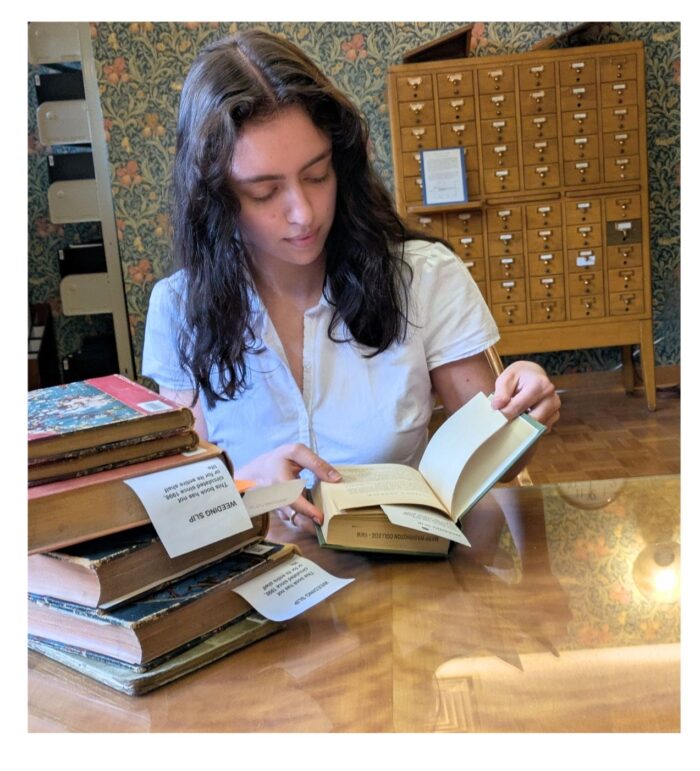
Person reading at a wooden table in a library, with stacked books, a card catalog, and shelves in the background.
Natalia Ramirez looking reviewing books in the reading room

In addition to working with rare books, I am helping to build digital subcollections focused on the Rare Books room’s art historical holdings. This involves categorizing the materials I cataloged last semester, researching their correlation with one another in the context of a specific subcollection’s theme, and ensuring that digitized items are accessible for researchers and students from a public-facing library webpage. These digital collections help to make the collection’s invaluable resource for those studying art history much more accessible, while advertising the importance of rare and fragile materials in cultural and historical research.

As I continue my internship, I look forward to uncovering more hidden gems within the collection and contributing to the accessibility of these resources. This experience has deepened my understanding of both archival work and practical contributions to art history, further igniting my passion for preserving and sharing cultural heritage.

New Additions to the Alumni Oral History Collection: Stories from Black Alumni

In recent years, Special Collections and University Archives has been fortunate to partner with Dr. Erin Devlin’s History 441: Oral History class and Alumni Relations to create and grow a digital collection of alumni oral histories. Collected stories from the LGBTQ+ Alumni Affinity Group became the first exciting product of this relationship, and we highlighted this process back in 2021 when the Alumni Oral History Collection first publicly debuted.

For the next collection of oral histories, students in Dr. Devlin’s class interviewed alumni from the Black Alumni Affinity Group in the spring of 2021. As we were still in the heaviest throes of the COVID-19 pandemic, interviews took place over Zoom. This presented a new challenge for us in the processing phase, since all of our content must be accessible and we had to ensure accurate captions for the video component.

Screenshot from a Zoom interview shows a Black woman with glasses against a blue backdrop.
Screenshot of oral history interview with Melanie Kay-Wyatt

The interviews tell insightful, compelling stories that hit on a variety of topics. Many alumni from the 1980s and 1990s spoke about the impact of having Civil Rights leader James Farmer as an instructor. Others spoke on their experiences being Black at Mary Washington, especially at a time where the school struggled to build a diverse student body. Participants spoke openly about the challenges of being on a predominantly white campus and facing instances of microagressions, prejudice, and overt racism. They also told about the deep and continuing connections they built here at Mary Washington with their peers and with faculty and staff members.

Encouraged by the people around them on campus, many of these narrators found their passion and began their career dreams here. One alumna took her Mary Washington chemistry degree into a fascinating career in the film industry. Others took lessons that started here and built incredible professional lives focused on education, law, and publishing, to name a few. But it wasn’t only the educational experiences that the participants reflected on; many of these alumni were active in various campus organizations, attending regular social events, or participating in athletics, developing close friendships that hold strong through today.

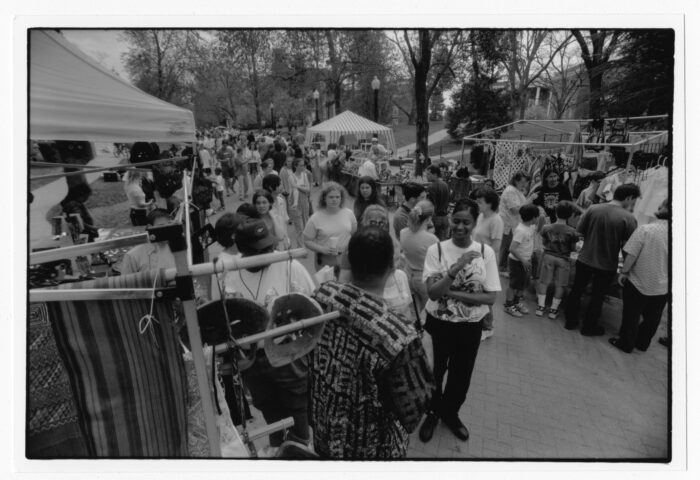
Several alumni fondly remembered Forrest Parker and the early days of the Multicultural Center, which began thirty-five years ago when Parker became founding director. They talked about finding a support system there before they even officially enrolled, and about the closeness they formed with other students while working to put together the renowned Multicultural Fair. Happily, the legacy promoted by Forrest Parker and supported by many of these alumni continues on as the Multicultural Fair prepares for its thirty-fifth celebration on Saturday, April, 5.

A large crowd of people gather at an outdoor fair. There are several tents and tables with vendors selling clothing and other items.
Multicultural Fair, 1997. Photo by Barry Fitzgerald.

UMW Special Collections and University Archives is honored to hear and to preserve these stories from our alumni. Forrest Parker was once quoted in the student newspaper challenging students of all races and ethnicities to strive for diversity because we all need that broad range of perspectives and to experience different cultures. We hope that by sharing these valuable oral histories, listeners can perhaps gain a fuller and richer understanding of our whole, diverse, remarkable Mary Washington community.

Great Lives in Rare Books: Dr. Bulent Atalay

Great Lives 2025 lecture series logo with the subtitle ‘Biographical Approaches to History and Culture.

This post was written by Haley Cotton ’25, Special Collections & University Archives Student Aide

Cover of a the book "beyond genius" by Bulent Atalay

Dr. Bulent Atalay is a distinguished faculty member at the University of Mary Washington. Beginning his career at the University in 1966, he is now Professor Emeritus of Physics, specializing in Theoretical Nuclear Physics. Dr. Atalay has made significant contributions to academic discourse by blending science and art in his work. He has authored both academic research papers and books, and created art that has been displayed in the United States and the United Kingdom.

Two books on a wooden surface: one titled Leonardo’s Universe and another featuring the Mona Lisa on the cover

Dr. Atalay’s latest book, Beyond Genius: A Journey through the Characteristics and Legacies of Transformative Minds, explores the lives of pivotal historical figures such as Leonardo da Vinci, William Shakespeare, Isaac Newton, Ludwig van Beethoven, and Albert Einstein. The book examines how their work has influenced both the arts and sciences. Dr. Atalay delves into why society regards these iconic figures as “geniuses,” exploring what it means to fall into this category and how we define it. If you’re interested in his academic discussion, attend the Great Lives Lecture on Thursday, March 13 for his presentation.

UMW Special Collections and University Archives (SCUA) houses a variety of his published works. Books such as Math and the Mona Lisa: The Art and Science of Leonardo Da Vinci (2004) and Leonardo’s Universe: The Renaissance World of Leonardo Da Vinci (2008) are available in both the Simpson Library collection and the SCUA. Other works, including The Lands of Washington: Impressions in Ink (1972) and The Oxford and the English Countryside: Impressions in Ink (1974), are housed in Special Collections. These series of works are compilations of art pieces by Dr. Atalay, depicting scenes of historic Virginia’s countryside and the landscapes around Oxford, England.

Four large booklets stacked, including three titled The Lands of Washington and one titled Oxford and the English Countryside.

You can visit these collections during open hours or by scheduling an appointment to view Dr. Atalay’s art pieces!

Great Lives in Rare Books: Captain Cook

Great Lives 2025 lecture series logo with the subtitle ‘Biographical Approaches to History and Culture.

Captain James Cook, a renowned British explorer, cartographer, and naval officer, was famous for his extensive voyages in the 18th century. Cook is credited with being the first recorded European to make contact with the eastern coastline of Australia and the Hawaiian Islands. During his voyages, he sailed thousands of miles across largely uncharted regions of the globe, mapping lands from New Zealand to Hawaii in the Pacific Ocean with unprecedented detail and on a scale not previously achieved by Western explorers. Cook’s legacy of knowledge significantly influenced the world well into the 20th century. However, due to his role in British colonialism and the exploitation of indigenous peoples, his expeditions and legacy remain controversial.

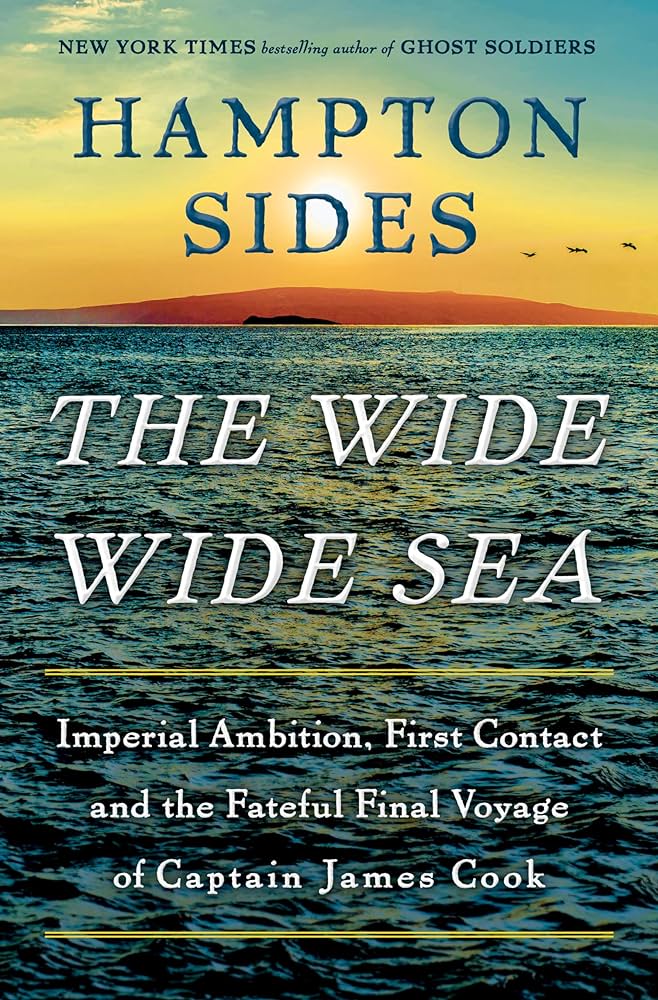
Book Cover of "The Wide Wide sea" By Hampson Sides

If you’re interested in learning more about Captain James Cook, stop by the Great Lives lecture on Tuesday evening, February 18, to hear from author Hampton Sides. Sides’ recent book, The Wide Wide Sea: Imperial Ambition, First Contact, and the Fateful Final Voyage of Captain James Cook, examines Cook’s last journey aboard the HMS Resolution, delving into the “complexities and consequences of the Age of Exploration.” The book is also available to view and borrow from Simpson Library.

In addition, stop by Special Collections & University Archives (SCUA) to view a contemporary account of Cook’s voyages – the story that those living in the late 18th century may have read about Cook and his expeditions. SCUA holds a 1773 edition of An account of the voyages undertaken by the order of His present Majesty for making discoveries in the Southern Hemisphere, and successively performed by Commodore Byron, Captain Wallis, Captain Carteret, and Captain Cook, in the Dolphin, the Swallow, and the Endeavour: drawn up from the journals which were kept by the several commanders, and from the papers of Joseph Banks, esq. As the title explains, this publication is an account of several Royal Navy voyages undertaken by Captain Cook and others. Compiled by John Hawkesworth, the books draw from the personal journals kept by the expedition leaders along with the papers of Joseph Banks, a naturalist who traveled with Cook. While the books were popular and provided an early account of the expeditions for interested readers, they were also heavily criticized even just shortly after publication.

A collage of two images. The first is a photo of all three volumes of the book set. The second is a picture of the title page of one of the books.

An account of the voyages undertaken in the Southern Hemisphere was originally published in three volumes and SCUA holds a complete set. Like many of the sets in our collection, the condition of each volume varies and it is clear that they were heavily read and used. While fragile, the books are available for gentle use and viewing in the Reading Room during open hours and by appointment. For further reading, you can check out digitized versions of the set available from the Library of Congress and the Internet Archive.

The Man Farthest Down: A Record of Observation and Study in Europe

Booker T Washington  sitting legs crossed at a table with a newspaper

Booker T. Washington was a prominent African American educator, author, and leader in the late 19th and early 20th centuries. Born into slavery in Virginia on April 5, 1856 and liberated during the Civil War, Washington became one of the most influential leaders of the time. Washington graduated from Hampton Normal and Agricultural Institute in Virginia (now Hampton University) and, known for his strong support of and contributions to education, he later helped found and lead the Tuskegee Normal and Industrial Institute (now Tuskegee University) in Alabama. While Washington’s ideas and visions did not go unchallenged or without disagreement, his impact on education and civil rights remains significant.

Red book titled "The Man Farthest Down: A Record of Observation and Study in Europe" on book stand by a window

UMW’s Special Collections & University Archives holds an early copy of one of Washington’s books, “The Man Farthest Down: A Record of Observation and Study in Europe.” Written in collaboration with sociologist Robert Park, The Man Farthest Down documents their travels across Europe in 1910. The book provides a detailed account of the living conditions of the urban poor and working-class individuals in various European cities. Washington and Park aimed to highlight the struggles faced by these marginalized groups, and to draw parallels with the challenges faced by African Americans in the United States. Through their observations, they sought to offer insights into potential solutions for improving the lives of the working class.

Open Book sitting with front cover resting on book pillow to support damaged spin

The first edition (1912) copy of this book housed in Special Collections has a simple deep red cover with the title embossed in gold lettering at the top. The book itself is in good condition with varied signs of its usage over the last century, including a slightly detached cover that must be handled with care. Another attribute that makes this copy feel so special: it was signed by the author himself, to Lucretia Ferguson Lewis on December 20, 1913. Not only was this book once in the hands of Washington, but it was also inscribed to Dr. James Farmer from Lucretia Ferguson Lewis on September 6, 1941, at the 26th annual Fellowship of Reconciliation (FOR) Conference.

Front endpaper with inscription " To
Miss Lucretia Ferguson
with kind wishes
of
Bona M. Withington
Tuskegee,
Ala.,
Dec. 28, 1913"

While books from Special Collections & University Archives don’t circulate, visitors are welcome to view and engage with books, including Washington’s The Man Farthest Down, by stopping by the Reading Room during open hours or by making an appointment. To access more books written by Booker T. Washington, visit the Library’s website.

Bibliography:

  • Wells, C. J. (2024, May 3). Booker T. Washington (1856–1915). Encyclopedia Virginia. https://encyclopediavirginia.org/entries/washington-booker-t-1856-1915/
  • Schomburg Center for Research in Black Culture, Jean Blackwell Hutson Research and Reference Division, The New York Public Library. “Booker T. Washington.” New York Public Library Digital Collections. Accessed February 4, 2025. https://digitalcollections.nypl.org/items/510d47df-9e0b-a3d9-e040-e00a18064a99
  • Washington, Booker T. Up from Slavery: An Autobiography (Garden City, N.Y.: Doubleday, 1963) 

Art in Print: Illuminating a Creative History

Special Collections Spring Exhibition

This post was written by Natalia Ramirez, Fall 2024 Special Collections & University Archives Intern.

Aiming to highlight the diverse range of rare books that the University of Mary Washington’s Special Collections and Archives has to offer, this exhibition explores the art history collection, providing a global survey from prehistory to contemporary time periods. Spanning from the Americas, Asia, Arabia, Europe, and North Africa, these books seek to highlight the diverse styles, materials, and contents, while also exemplifying the global interconnectedness throughout history. Taking a chronological approach, this exhibition acknowledges the limitations of historical periodization, while appreciating the groundwork for historical understanding that has been laid.

This exhibition, displayed conveniently right outside the Special Collections and Archives’ doors in the Simpson Library, was curated by student Art History major Natalia Ramirez, class of Spring 2025. Supervised by Angie Kemp, the creation of this exhibition spanned the entire Fall 2024 semester, and came together with the Special Collections team as a whole. Excitingly, this exhibition will remain on view until the end of this Spring semester in April, and has an accompanying digital and printed catalog available to the public.

Cover of Exhibition catalog title text reads Art in print Illuminating a Creative History. subheading Special Collection & Archives University of Mary Washington fall 2024 through 2025 cover Image is "The Life of the Buddha according to thai temple painting" below  left to right reads Rare Book exhibition Curated and researched by art history student intern  Natalia Ramirez
The exhibition catalog is available to view online.

This exhibition has been curated to survey a global Art History utilizing the University of Mary Washington’s collections. For background on its contents, throughout history, a broad range of materials have been used by the hands and minds of innumerable artists to create physical representations of values, ideas, and the worlds around them. Documenting even a fraction of these works in edited collections, facsimiles, and commentary literature has contributed to their preservation and broadening education. Many of these books which document creative histories become part of the creative history themselves, serving as ‘signs of the times’ for the state of art literature since the dawn of written documentation.

Rare Book Display on behind glass
The exhibition is available for viewing outside of Special Collections when the Library is open.

This collection’s objects date back as early as the mid-Medieval period (approximately 500 CE through 1400 CE), with original Arabic papyrus inscriptions and Latin illuminated manuscript fragments. These pieces, along with many others show that written artifacts can be appreciated and displayed as artworks for their creative cultural contributions. From linen rag, papyrus, parchment, and vellum, this exhibition’s paper variety exemplifies the range of printing materials and methods that have been used in different places and at different times.

Student standing front of rare book display that is behind glass
Natalia Ramirez ’25, curator of “Art in Print: Illuminating a Creative History

History in Scrapbooks

This post was written by Sandy Llop, Fall 2024 Special Collections & University Archives Intern.

Left photo is a student at a computer editing a scanned scrapbook.
Right photo is a student standing at a bookscanner scanning a scrapbook
Intern Sandy Llop using the Cobra Book Scanner

Over the course of this academic year’s fall semester, I had the opportunity to be an intern at the University of Mary Washington’s Special Collections and University Archives. In the four months I spent working there I was able to explore some of Simpson Library’s most interesting resources: the scrapbooks of Mary Washington alumni and student groups of years long past. With the earliest scrapbook dating back to the mid-1910s, this collection is a treasure trove of history and ephemera of their time periods. For my internship, I was tasked with digitizing some of these memory books so that they may be available online for Mary Washington students, researchers, and history buffs alike via the University’s Digital Collections.

Scrapbook on table collaged cover
Scrapbook by Frances Edmonds Johnson 1928-1931

Although every scrapbook in the collection is fascinating and important in its own way, only a few could be chosen for my particular project. After a few weeks of research, the final contenders for digitization were picked. The first was the scrapbook of alumna, Frances Edmonds Johnson, a student who attended UMW during the years 1928-1931. The second was the scrapbook of the MWC of UVA Defense Program, a program that was sponsored by the university’s Student Government Association during the Second World War that oversaw the buying and selling of war bonds on campus. The third was the scrapbook of the Cotillion Club, a social club which held formal dances for students from the years 1938-1948. The second of the three scrapbooks can be found in the Simpson Library Digital Collections under ‘Scrapbooks’.

Scrapbook on table with a cut out image of a forest glued to cover
Scrapbook by Beverly Munn, 1941-1944

While working with these memory books I not only learned about the ways in which they are preserved but also the kinds of tools and materials used in archival work. For example, the digitization process included steps such as scanning the scrapbooks at the Digital Archiving Lab at the Hurley Convergence Center, editing the scanned images in Adobe software like Photoshop, and creating alternative text that would be applied to the PDF file of the scrapbook for accessibility. In addition to this, I also learned about the other factors that come into play, like copyright and privacy laws, when making objects like these accessible to the public. I was even able to observe the acquisition of the newest addition to the collection, the scrapbook of alumna, Beverly Munn, a student who attended UMW during the years 1941-1944.

Overall, I couldn’t have asked for a better experience. I learned so much during my internship at Mary Washington’s Special Collections and University Archives. I learned about the history of Mary Washington and its student life, about important events in local history such as the Fredericksburg Flood of 1942, and about the work of students raising money for the war effort. It is amazing the amount information that can be gleaned from a scrapbook. It is a glimpse into the past through the eyes of the person who created the memory book. I hope that the patrons of Mary Washington’s Simpson Library enjoy exploring this collection as much as I did and that the history of these scrapbooks can live on for many more years to come.

Student presenting archival artifacts, rare books and scrapbooks on a table in the lobby of library
Intern Sandy Llop assisting in a tabling event for the 2024 Virginia Archives Month