This post was written by Emma Galvin ’25, Special Collections & University Archives Intern, in May 2025.
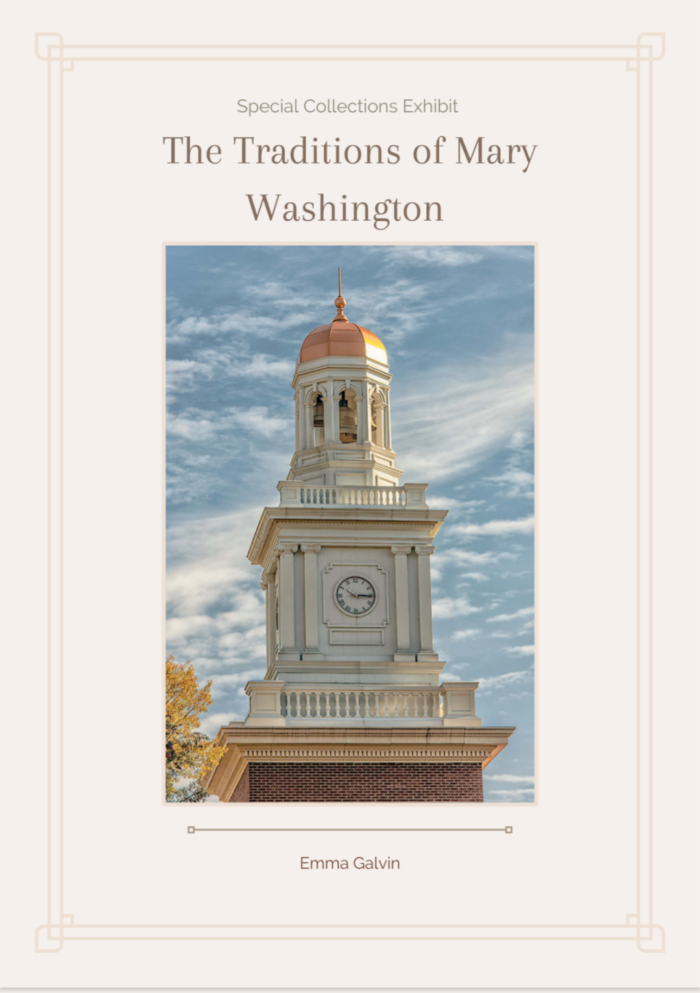
During the 2025 spring semester at the University of Mary Washington, I had the opportunity to work with Special Collections at Simpson library on campus. The goal of this internship was to not only complete the academic requirement for the museum studies minor, but for me to learn what it takes to work with collections, artifacts, and learn the in and outs of exhibit planning. By the end of this internship, the objective was for me to create an exhibit within the library based on the artifacts special collections had in their inventory.
One of the first things I did while here was watch a few webinars on what scrapbooks were, the process on conserving and preserving them, the proper storage care, what they can potentially tell us about the time they were made, as well as some of the copyright issues that might pop up with scrapbooks. Preserving scrapbooks can be fairly tricky due to the various types of objects that are put into scrapbooks and how those objects are affixed to the pages. Scrapbooks aren’t made with longevity in mind. Its pieces of paper and mementoes of all sorts glued into a book. Not only does the paper get more fragile as time goes on, but the glue does as well leaving many of the objects prone to falling off or out of the scrapbook. Due to the different materialities of objects displayed, there isn’t often one preservation method needed when preserving these books. I had to keep this in mind when I was going through the scrapbooks they had in their collection.
After learning about scrapbooks, I could finally start going through them. I needed to familiarize myself with the content of the books to try and come up with an exhibit topic. This meant going through 20+ scrapbooks and taking notes of what I found in the pages. These scrapbooks were mostly from former alumni who scrapbooked their time at the college. The scrapbooks I looked at started as early as 1917 and went through the late 1950s. When going through them, I started noticing how many traditions, clubs and events that were highlighted over this 40 year period. Most of what I found were campus traditions that were started by students and staff. The four that were mentioned the most were May Day, the Daisy Chain Ceremony, Peanut Week, and Devil-Goat Day. All of these traditions have long since ended, except for Devil-Goat Day which still occurs to this day.
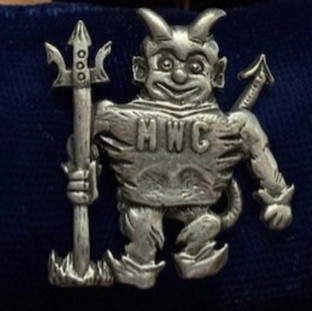
To further understand what these traditions were, I read through two books. The first called History of Mary Washington College 1908-1972 written by Edward Alvey Jr. and the second being University of Mary Washington: A Centennial History 1908-2008 written by William B. Crawley Jr. Through looking at the information these books provided, as well as going through past UMW yearbooks, and using letters and information from the scrapbooks themselves, I had enough information to write the introduction labels for each tradition. After this, I started making a list of all the objects I would like to put on display. During my research, I found many photographs depicting the various traditions within Special Collection’s digital repository. I also found yearbooks with good images and quotes to display, as well some actual artifacts that could be displayed. Items such as felt goats made for Devil-Goat Day in the 1930s, and decades worth of May Day programs.
The scrapbooks had valuable objects to display as well. The issue with these artifacts is that most of them were affixed to the books themselves. Due to the fragility of most of these scrapbooks, they weren’t suitable to be displayed open. Instead, I scanned in the pages of the objects I wanted to display, printed them out, and then showcased them next to their respective scrapbooks.
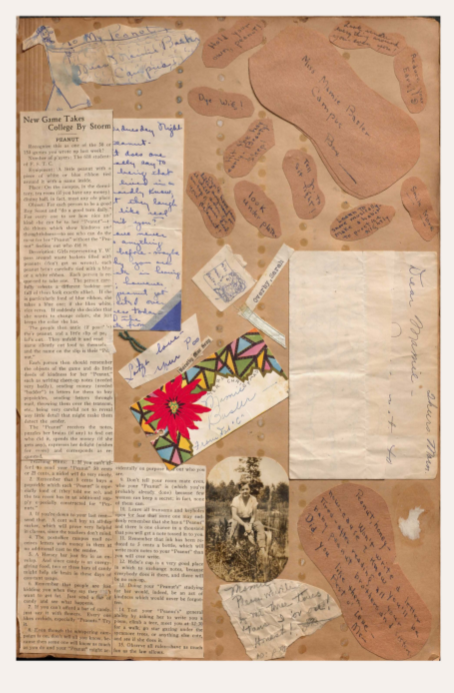
Finally it was time to set up the display. After printing out the photos and cutting out the objects labels I spent a couple weeks writing, I had enough to start planning the layout. Initially, to get a general sense of spacing in the two display cases I could use, I decided to only set up with the photos, labels and placeholder items. Those included stands I planned on putting artifacts on as well as picture frames roughly the size of the items I planned on displaying. This helped me realize that some sections of my display were spaced perfectly, some had too many items, and some spots needed additional artifacts to fill up the space. To plan that out, I used an editing tool on my phone to draw in where I think objects should go. This helped me rework the initial plan I had for the exhibit into a layout that would actually work. Since the tradition of May Day went on for so long, I could fill up one entire display with information on just that tradition alone. Because of that, and the comparatively less information on the traditions of Peanut Week and the Daisy Chain Ceremony, I figured out I could fit those traditions along with Devil-Goat Day in the other display case. I spent a couple of weeks setting up the display and figuring out the display props I could use to safely prop up some of the items. There were a few weirdly shaped objects, such as two felt goats I decided to display, that took some brainstorming to figure out the best way to safely prop them up and make them visible without ruining or harming the integrity of the object. Overall, this semester was a great experience and I learned a lot about the ins and outs of label writing, exhibit planning, and working with existing collections to try and come up with a meaningful narrative to display.
Read more about “The traditions of Mary Washington” by clicking this link to the catalog or visiting the exhibit displayed in the Special Collections and University Archives case from spring to fall 2025 on the 2nd floor of Simpson Library.
