This post was written by Caitlin Ervin ’28, Special Collections & University Archives Student Worker
October 2026 is the 20th anniversary of Archives Month. With this year’s theme being Remember Me: Death and Memorial in the Archives, we turned our attention to the recent passing of Gloria Steinem, who died on September 2, 2026. She is best remembered as a driving force of the American women’s rights movement, as well as an accomplished journalist, lecturer, and co-founder of women’s political organizations. Steinem made her most influential marks on students at Mary Washington College through her outspoken political presence and visits to Fredericksburg in the 1970s and 1980s. There is no better example of her impact than straight from the students themselves, through the campus newspaper of the era, The Bullet.
Feminism and a Changing School
September 20, 1971, saw the first appearance of Steinem’s name in a student publication at Mary Washington College. Robin Darling ’72, then-Editor of The Bullet, wrote a piece about the National Women’s Political Caucus, an organization dedicated to supporting more female political candidates, of which Steinem was a co-founder. The National Women’s Caucus was far from the only reference to feminist concerns in this issue. A prominent topic featured both on the front page and in the Editorial section was the legal threat faced by The Bullet‘s editorial staff for printing an advertisement for an abortion-referral service in the previous issue.
The very next issue of The Bullet from September 27, included a transcription of Steinem’s speech from the Virginia Women’s Caucus in Richmond.
“I say that because I think that we should understand that one of the most important, compassionate, humanizing forces that women have to offer is that we make these kinds of connections through artificial barriers of race and class because we have common problems and We have to work on them together, get all kinds of coalitions. [. . .] This sexism and racism are the social ills that we are talking about and we have to unite against them. As long as we look different from the ruling class, as long as we have any kind of visible physical differences, we are subject, given these ills of sexism and racism, to being put in a second-class group.” – Gloria Steinem, as referenced in “Steinem: ‘The one who sucks best, wins,'” The Bullet (Fredericksburg, VA), September 27, 1971, 4
This speech occurred in a year already full of major change at Mary Washington. 1971 brought about the decision to separate from the University of Virginia, as well as being one of the first years operating as a co-educational school. The remainder of publications for the 1971-72 academic year continued with debates among students on feminist issues, several of which referenced Steinem’s activism:
If one analyses the statements made by Gloria Steinem and the slate of proposals drawn up by the Caucus it readily becomes apparent that neither Steinem nor the Caucus are interested in bringing about a humane society. What they are after is power, pure and simple; [. . .] They do not wish to eliminate sexism, but are working frantically to foster the expansion of sexism. They do not wish to work for the principle of individual rights, for it is apparent that they do not have the slightest conception of this fundamental precept, the application of which is absolutely essential to the establishment of a free, and thus humane, society.” – Thomas Johnson, “Unadulterated sexism,” The Bullet (Fredericksburg, VA), October 14, 1971, 4
Also note that the Caucus demands the use of a quota system based on sex for the evaluation and selection of delegates to national conventions. They do not advocate the selection of delegates based on their interest, ability and desire to attend the conventions; no. they base their demand on gender. And we are told that Steinem wants an “end to the evaluation of people according to race or sex.” In reality, what we are really witnessing is pure, unadulterated sexism practiced by the women liberationists.” – Thomas Johnson, “Unadulterated sexism,” The Bullet (Fredericksburg, VA), October 14, 1971, 4
Women attending women’s colleges in this country today are constantly being met with the degrading question, “How do you get along without men?” The retort to such a question could easily be, “Who needs them?” However, a slight alteration could turn it into a serious answer, “Who needs them now?” Why necessarily are men needed at this period in a girl’s life?” – Joan McAllister, “Advantages of sexual segregation,” The Bullet (Fredericksburg, VA), January 31, 1972, 3
Women must stop being reared to be subservient and inferior to their husbands. Girls are usually ahead of boys in academics through elementary and high school and should be encouraged at this time. It should be made known to them that they too should plan on careers in future life. Girls in their early years are not given enough push or encouragement to have a career. Thus, when they reach college perhaps they would really like a career but instead give into the easier and more secure way of motherhood. They do not have to face up to themselves, because they know that people do not expect anything more from them.” – Joan McAllister, “Advantages of sexual segregation,” The Bullet (Fredericksburg, VA), January 31, 1972, 3
Today’s co-ed colleges are not the answer even though they do have a more natural atmosphere. With the situation as it is now, women cannot really accomplish anything at a co-ed school. They are still talked down to and not given a fair chance. Men are not necessarily the enemy, but women cannot fairly communicate with them in the current situation.” – Joan McAllister, “Advantages of sexual segregation,” The Bullet (Fredericksburg, VA), January 31, 1972, 3
In July 1972, Trinkle Library subscribed to the magazine Ms., a publication spearheaded and edited by Gloria Steinem, adding it to the list of periodicals available to students. This was part of a move by the library to make more feminist texts available to students. A few months previous, in January, student editor Robin Darling had written a scathing review of the magazine for The Bullet:
MS. took the familiar tone of any of the prosperous women’s magazines already in existence, published and edited by men, for women. Worse, women wrote MS., and they wrote it in the old familiar way that LADIES’ HOME JOURNAL or REDBOOK writes for its feminine readers: down. The same patronization, the same cutesy style couldn’t disguise what the (women) editors had done; they had sized up their audience as the young, with-it libs, and they were patronizing them on almost every page.” – Robin Darling, “MS: a disappointment to feminists,” The Bullet (Fredericksburg, VA), January 31, 1972, 5
The only article by a man is a longish, rather nervous column by Nicholas von Hoffman, the Washington POST’S house radical. “Son of Women’s Lib,” he calls himself, and writes a eulogy/testimonial about his successful professional mother. She is an admirable and competent woman, no doubt; but by the time her son had finished the column, she came off like a Most Unforgettable Character in READERS’ DIGEST.” – Robin Darling, “MS: a disappointment to feminists,” The Bullet (Fredericksburg, VA), January 31, 1972, 5
The second is the content based on the assumption. This includes advertisements (“Liberate your Martini” with X vodka) and articles full of helpful suggestions which instruct the modern lib on the ways to make a marriage contract, get it on with her sisters, and, not surprisingly, how to vote. All of them push for women as the successors and usurpers of the present male chauvinists. All of them would style women into the “ideal” form for living in the world; they accept as their model the upwardly mobile male of the American business and professional scene.” – Robin Darling, “MS: a disappointment to feminists,” The Bullet (Fredericksburg, VA), January 31, 1972, 5
Gloria Steinem Comes to Fredericksburg
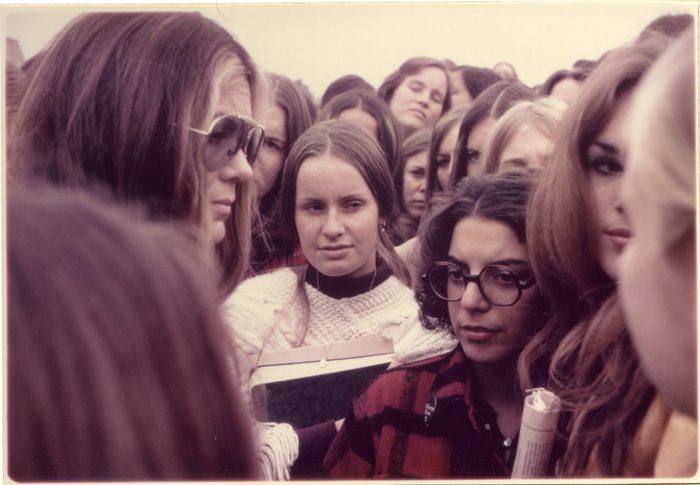
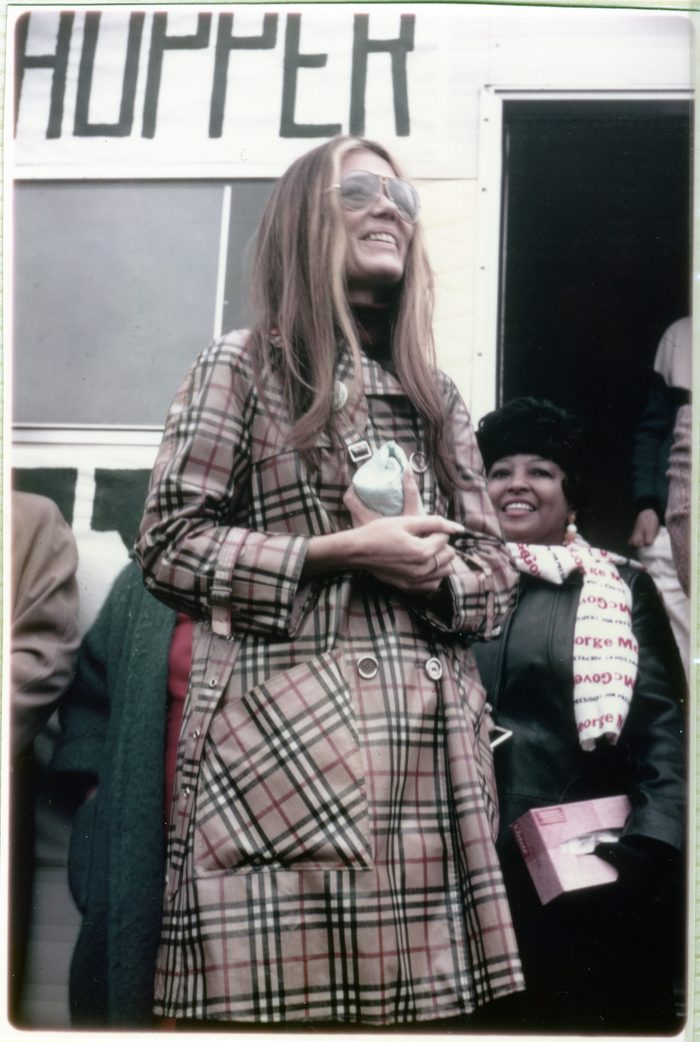
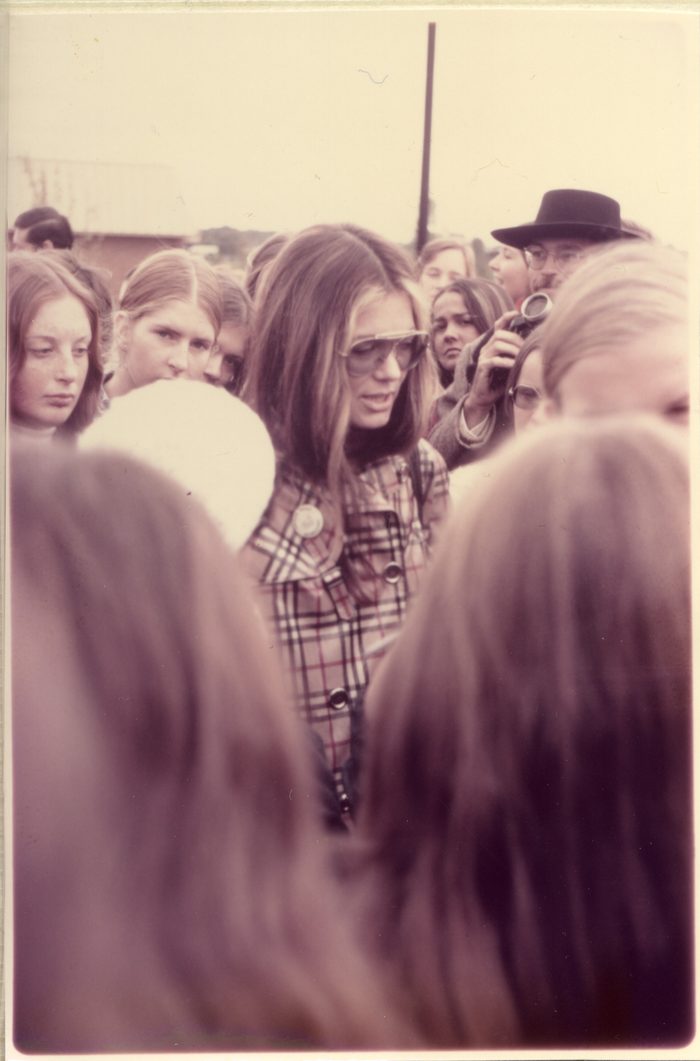
The Fall of 1972 brought about not only continued reference to Gloria Steinem, but an actual appearance by her in Fredericksburg. In October, she visited as part of the Grassroots Grasshopper, a converted bus carrying various celebrities and public figures on a southern tour campaigning for presidential nominee Senator George McGovern. While she did not visit the Mary Washington campus itself, she did give a speech at the Sheraton Hotel which was attended by a group of students via an MWC-provided bus. Students of that time, including many who were part of the McGovern campaign on campus, remember Steinem’s visit as a highlight of their Fall semester.
Photographs taken by English professor Daniel A. Dervin provide a record of Steinem’s 1972 visit. A few of the students in these photos were identified by their former classmates via the University of Mary Washington Magazine in 2012.
Gloria Steinem Speaks on Campus
In the Spring of 1986, the MWC’s Student Association Executive Cabinet invited Steinem to speak at Dodd Auditorium. Her visit was an all-campus endeavor co-sponsored by MWC’s chapters of Circle K, the National Organization of Women, and the students of Hamlet House, which at the time was the men’s “Scholarship, Leadership, and Service” residence hall.
On April 8, she gave a lecture entitled, “Women of the ‘80s: The Second Wave” (though, in an article from MWC Today it was titled, “The Women’s Movement: Its Past, Its Future”). Regardless of what it was called, Steinem discussed the rising tide of second wave feminism in response to political conservatives. She acknowledged signs of improvement for equality, such as the introduction of gender-neutral terms for work positions but also lectured on the continued need for guaranteed reproductive rights, economic freedom, and the recognition of household and family labor as work. A reception was hosted afterwards sponsored by the MWC Student Association and MWC Young Democrats.
And if you don’t believe that [there still needs to be improvement], ask a man if he would like to receive a spinster of arts’ degree, go to graduate school and get a ‘mistress of science’ and then try to get a ‘sistership.’” – Gloria Steinem, as quoted in April Stoops, “Steinem Confronts Humanist Issues,” The Bullet (Fredericksburg, VA), April 15, 1986, 3, 10
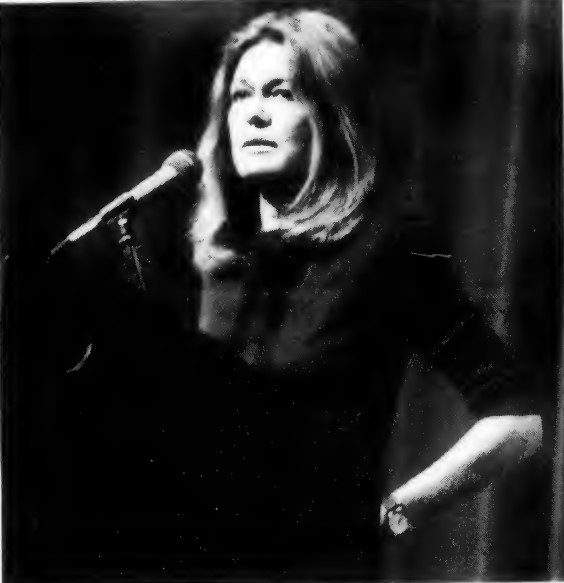
Steinem’s visit crowded Dodd Auditorium to near capacity and was regarded as “one of the more exciting things to happen on our campus this semester”. Her speech also provided the opportunity for students to debate her ideas and comments both at the lecture and in the next week’s publication of The Bullet.
Ms. Steinem’s quote was unjustified. Women’s equality has been a major concern of the Reagan Administration, as well as for all. As far as the women’s movement suffering from a “blacklash [sic]” is simply unfounded. The women’s movement has changed and must be approached differently than in the past. Women have gained many deserved rights in the past two decades, and are continuing to receive rights and equalities through the existing system and the Reagan Administration.” – Kelly Gould and Susan Brown, “Feminist Comments ‘Unfounded,’” The Bullet (Fredericksburg, Virginia), April 15, 1986, 2
The successful elements of Steinem’s speech were not only that [illegible] the student body got to hear an inspirational talk on the benefits of equality among the sexes or that once the liberal side of the coin shown without all the “paving road to communism” paranoia more importantly, many were challenged on their personal views. Conservatives in the audience exposed to the ideas that they never fully confronted before were forced to see the validity of other side. This does not mean all walked out born again feminists, but rather people walked out with ideas in their heads that could let them come to a more fair conclusion on which side to stand. Maybe there isn’t even a right side to be on, but no one can deny that Steinem’s lecture was eye opening.”– J. J. Baker, “Gloria Steinem—A Class Act,” The Bullet (Fredericksburg, VA), April 15, 1986, 7
There were a few who felt very threatened. They did not consider hearing someone else’s views, which happened to be in opposition to their own, as a worthwhile experience. Of course, after the speech there were the right wing conservatives, the anti-abortionists, and the fundamental Christians outside distributing flyers about the Feminist Facade. They were ready to prove that feminists are actually anti-God, anti-family, and most likely working for the Soviet Union. They were complaining that Steinem’s speech was terribly one-sided.” – J. J. Baker, “Gloria Steinem—A Class Act,” The Bullet (Fredericksburg, VA), April 15, 1986, 7
A lot of anti-abortionists were furious that Steinem was allowed to speak basically uncontested, but I don’t remember any pro-choice concepts being included in the literature they somehow managed to have slipped under our doors last year. Do you remember that?”– J. J. Baker, “Gloria Steinem—A Class Act,” The Bullet (Fredericksburg, VA), April 15, 1986, 7
In issues of The Bullet published during Steinem’s visits and the heights of first- and second-wave feminism, you won’t find any singular perspective among students. The Bullet recorded student opinion across all parts of the political spectrum and crossing gender lines. Steinem’s appearances and social influence may have been the impetus for these articles to be written, but these sorts of conversations were already happening on Mary Washington’s campus.
In the 1970s, and even today, topics related to feminism, including abortion and economic rights, were controversial. As seen throughout these issues of The Bullet, students faced a lot of backlash for printing their opinions, if not from other students, then from the college, the local community, and even lawyers. This controversy is part of what makes preserving these student newspapers so important. These conversations and events had actual effects on the lives of students and shaped their time at Mary Washington College. Over the years, our University Archivists have recognized this impact on students and made it part of their mission to collect and preserve student newspapers. Even though the materials themselves are ephemeral – they were meant for the people at the time they were printed – these items have been digitized and made available for modern students to read and learn from.
The University Archives has worked to preserve these students’ voices for over fifty years, however it’s also important to remember that the students themselves were the ones who documented their experiences in the first place. As we celebrate Archives Month, we not only consider the work of our professional archivists but also remember those who came before us as students. The students who once wrote for The Bullet also lived in our dorms, hung out with their friends on Ball Circle, and went to events at Dodd Auditorium. Though several decades may separate us, we can look back at their writings and see pieces of our own lives here on campus.
So, here’s to the history of Mary Washington . . . and a thank you to the students who wrote it all down!
Want to read more from students in The Bullet? Almost every issue since 1922 is available on SCUA’s Digital Archive. If you want to see more of Daniel Dervin’s photos from Steinem’s 1972 visit. You can find them on SCUA’s Digital Archive.
Bibliography:
