This post was written by Ilaria Eddins ’29, Special Collections & University Archives Student Worker
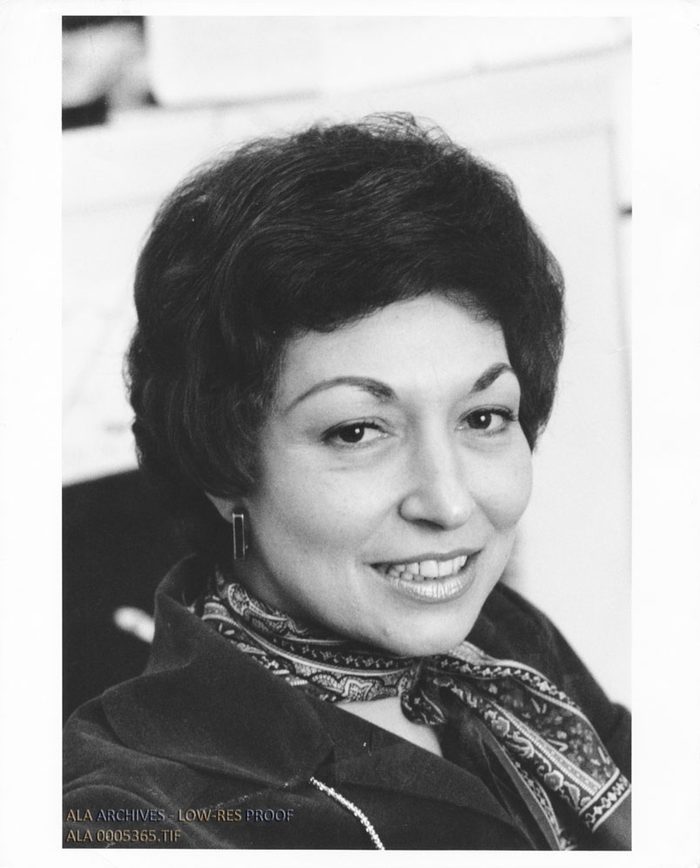
This year marks 44 years since the establishment of Banned Books Week in the United States. In 1982, following the Supreme Court case, Island Trees School District v. Pico—which ruled that books cannot be banned by school officials in school libraries simply due to their content—the combined efforts of the American Library Association’s (ALA) Office for Intellectual Freedom’s (OIF) director, Judith Krug, the American Booksellers Association (ABA), and the National Association of College Stores led to the initiation of Banned Books Week.
Though Banned Books Week only officially began in 1982, the history of banned books and censorship in the United States goes much further back. From the first ‘banned book’ in the U.S., which many scholars consider to be Harriet Beecher Stowe’s Uncle Tom’s Cabin (1852), to this year’s ALA top ten banned books list, people of the United States are no strangers to attempts made to hinder their intellectual and literary freedoms.
The University of Mary Washington’s Special Collections and University Archives (SCUA) Rare Books Collection holds multiple copies of one of the most important ‘banned books’ in the history of literary censorship in the United States. Ulysses, written by Irish author James Joyce and first published in 1922, faced severe treatment in the United States for over a decade following its publication and release. This included confiscation, banning, destruction (Van Doren & SCUA Staff 2022-23, 3), and legal ramifications for any publisher who tried to distribute it. Only in 1934, following the decision of federal Judge John M. Woolsey in United States v. One Book Called Ulysses (1933)—and the rejection of the federal government’s appeal to the case in 1934 by the United States Court of Appeals for the Second Circuit—was the book first officially and legally printed and published in the United States.
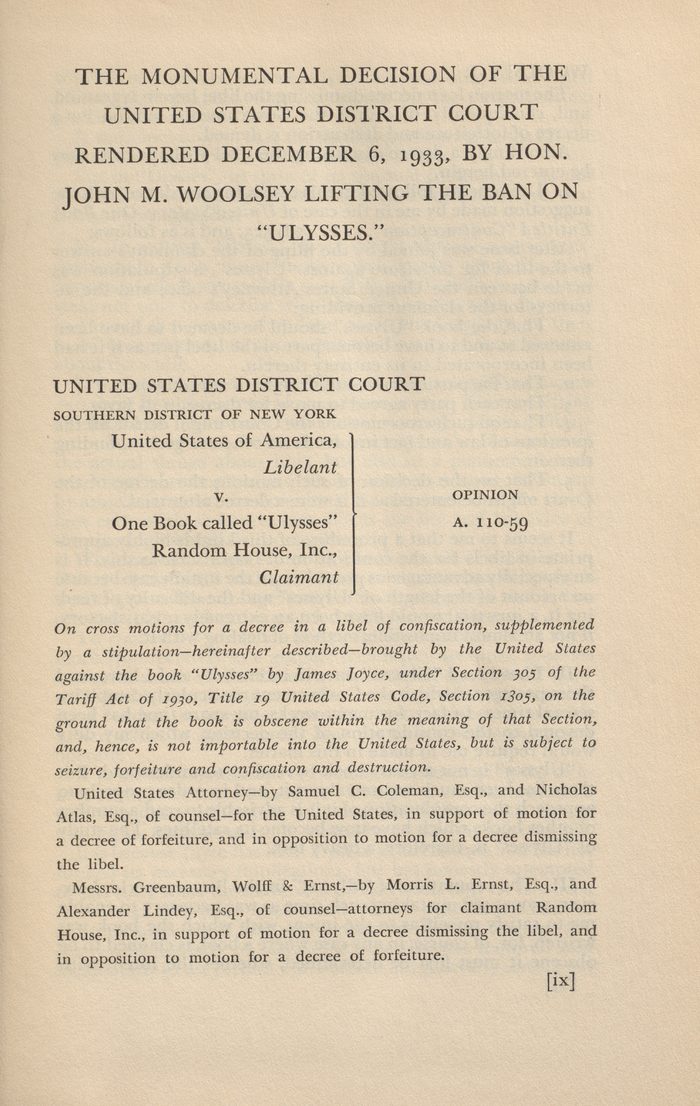
To fully understand the true magnitude of this decision, one must go back to the inception of the Act of the Suppression of Trade in, and Circulation of, Obscene Literature and Articles of Immoral Use, or more commonly known as the Comstock Act. In 1873 it was passed as a federal statute by the United States Congress and signed into law by the president that same year. Anthony Comstock, for whom the act was named, was founder of the New York Society for the Suppression of Vice—also beginning in 1873—and, following the signing of the Comstock Act into law by President Ulysses S. Grant, was sworn in as a special agent of the Post Office Department. As he liked to keep track of his accomplishments, Comstock bragged that he had, under his purview, “…counted 2,489,168 obscene pictures burned…28,428 pounds of stereotype printing plates destroyed…sixteen dead bodies” (Birmingham 2014, 173) and destroyed 50 tons of books. Ulysses first appeared in serialized form in The Review in 1918 and, since it was distributed by mail, ran into censorship problems almost immediately. When officials in the Post Office Department inspected these copies of The Review, they classified it as being in violation of the Comstock Act and set about to halting its distribution. Ulysses was first released in full in 1922. Under the Comstock Act, publishers in the United States were prohibited from bringing it into and distributing it around the U.S. As previously mentioned, only in 1934 was it first legally printed and published in the U.S. due to the revolutionary decision of Judge Woolsey. As mentioned by a Chicago literary columnist in 1934 in a review of Woolsey’s decision, it was “the greatest blow ever dealt against censorship in the Comstockian manifestation” (Spoo 2019, 4).
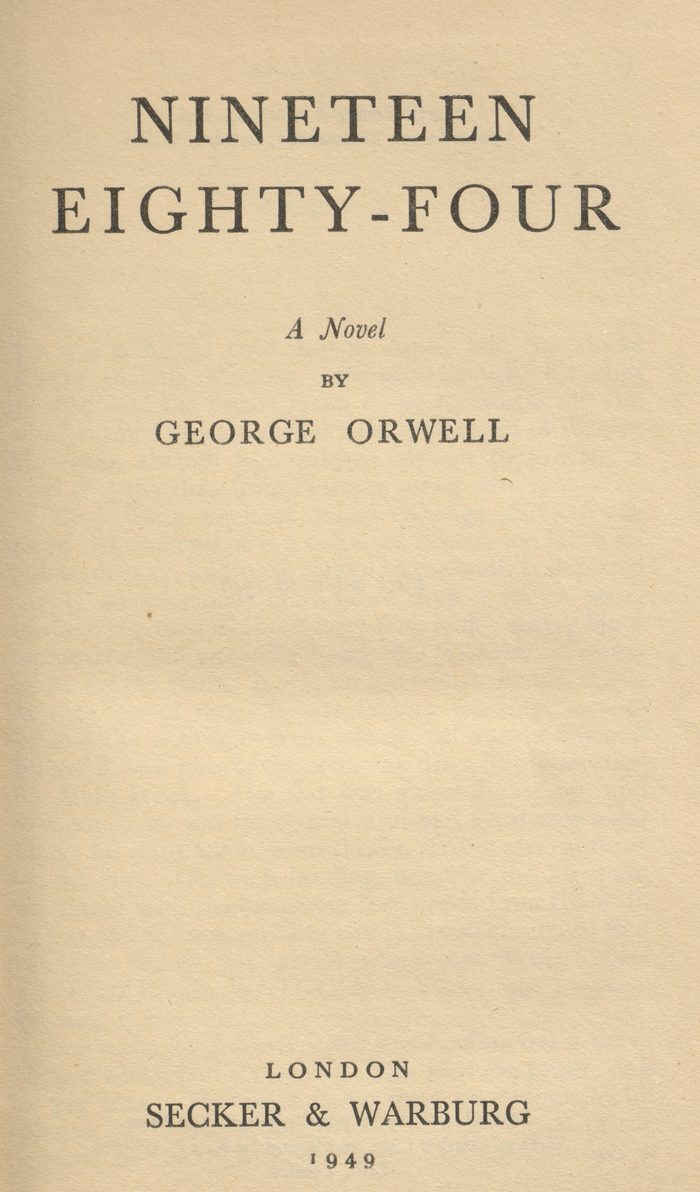
Following the trend of books banned for so-called ‘obscenity’, the book 1984 by George Orwell faced similar problems to Ulysses as it was challenged from the beginning of its publication in 1949. In a list of the 30 most frequently challenged books, compiled by English professor and advocate for intellectual freedom Lee Burres using data from six national surveys of censorship pressures on American schools, 1984 ranked fifth (Karolides et al. 2011, 129). The same criticisms that were made of Ulysses plagued 1984 as censors asserted that it was too sexually explicit. Many, especially in the United States, also claimed that it promoted communism and socialist utopias, which, as stated by a parent on a 1966 national survey, “…is wrong” (Karolides et al. 2011, 129). Today, the most common reason for 1984 being challenged, censored, or banned is due to its alleged sexual explicitness. Due to its ‘obscenity’, it is still commonly included in targeted efforts to ban books across America.
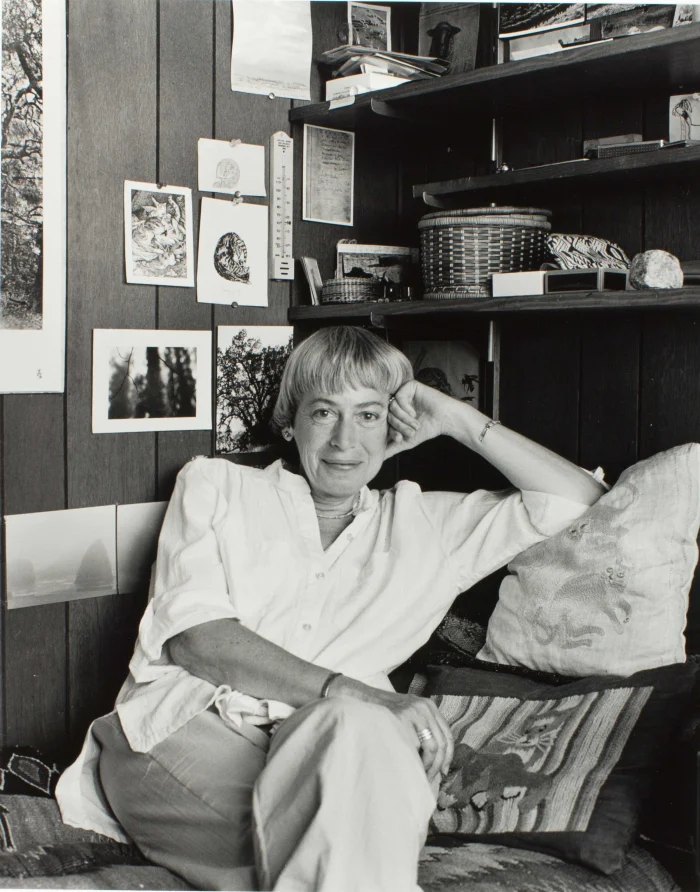
As Ursula K. Le Guin stated in her 2004 publication Talks and Essays on The Writer, The Reader, and The Imagination, “A dangerous book will always be in danger from those it threatens with the demand that they question their assumptions. They’d rather hang onto the assumptions and ban the book” (Le Guin 2004, 248). Author Ursula K. Le Guin, most famously known for her books A Wizard of Earthsea, The Left Hand of Darkness, and The Dispossessed, was born in 1929 to author Theodora Kroeber and renowned anthropologist Alfred Kroeber. Le Guin’s books were revolutionary, not only for the genres of science fiction and fantasy but also for overall literature, as they challenged traditional cultural notions about the constructs of social hierarchy, gender, sex, and sexuality (to name a few). The Left Hand of Darkness focuses on more complex ideas of gender and gender fluidity. Due to this, many believed that it was not suitable for minors, or anyone, to read and have attempted to get it removed from public school.
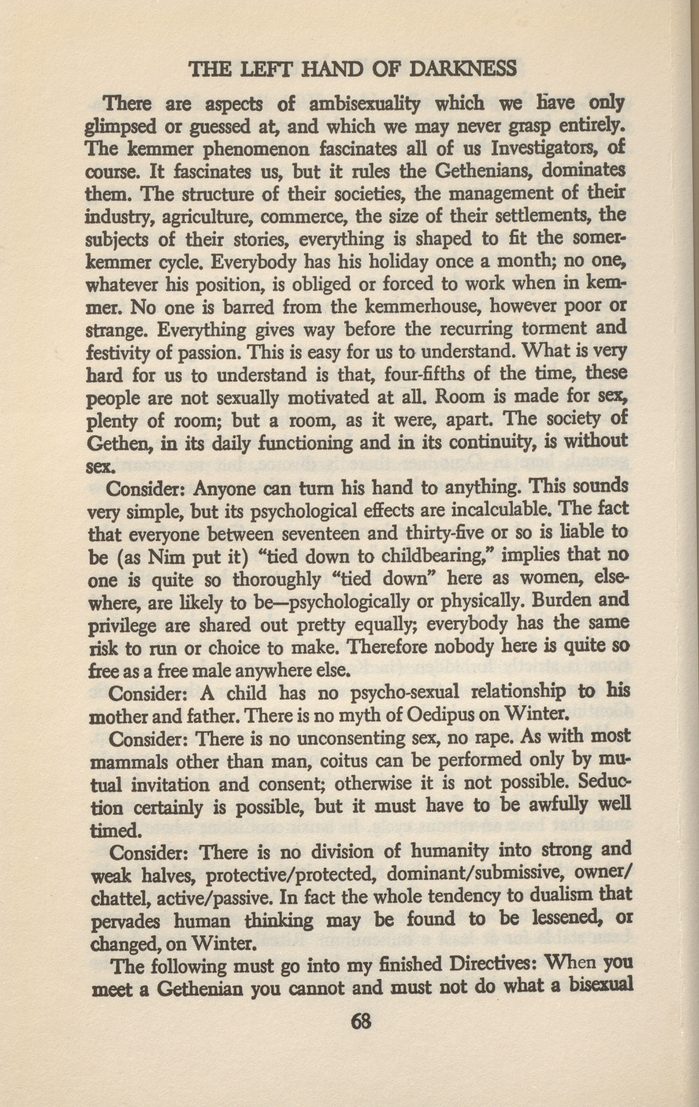
Le Guin herself, when asked in an interview about her work being banned, stated that simply because her books were imaginative, they were banned. In her opinion, stated in the same interview, “[t]he imagination is truly the enemy of bigotry and dogma” (Le Guin 2015).
From its beginning in 1982, Banned Books Week has been centered around promoting peoples’ rights to their intellectual and literary freedom. Intellectual freedom, as termed by the American Library Association in their Intellectual Freedom Manual, is “…the right of every individual to both seek and receive information from all points of view without restriction” (Jones 2015, 3). Even in 1934, people recognized that “…individuals are capable of being their own censors and it is absurd to impose upon them restrictions…” (Spoo 2019, 6).
SCUA houses many other books in addition to the ones that have been mentioned here that have faced challenges, censorship, and banning throughout the United States and abroad. In respect to your own intellectual freedom, ‘use it or lose it’ as some have said. Patrons are able to take advantage of the great resources the SCUA has through open hours and by making appointments.
References:
- American Library Association Archives Holdings Database. “Judith Krug (3) | The American Library Association Archives.” Accessed October 7, 2026.
- “Banned & Challenged Books | Banned Books.” Accessed October 7, 2026.
- Berninghausen, David K. “Book-Banning and Witch-Hunts.” ALA Bulletin 42, no. 5 (1948): 204–7. JSTOR.
- Brennan, William J., Jr, and Supreme Court Of The United States. U.S. Reports: Board of Education v. Pico, 457 U.S. 853
. 1981. Periodical. - “Censorship Search Portal | Banned Books.” Accessed October 7, 2026.
- Eberhart, George. “50 Years of Intellectual Freedom.” American Libraries Magazine, November 1, 2017.
- “Frequently Banned and Challenged Classics | Books & Books | Your Locally Owned Independent Bookseller.” April 29, 2014.
- Gravius, Sharon. “LibGuides: Banned and Challenged Books Week: History of Banned Book Week.” Accessed October 7, 2026.
- Pagnattaro, Marisa Anne. “Carving a Literary Exception: The Obscenity Standard and ‘Ulysses.’” Twentieth Century Literature 47, no. 2 (2001): 217–40. JSTOR.
- Spoo, Robert. “Judge Woolsey’s Ulysses Opinion: Early Print History and Reader Response.” Journal of Modern Literature 43, no. 1 (2019): 53–70. JSTOR.
- Stroshane, Eric. “On the Banning of Banned Books Week.” Intellectual Freedom Blog, October 7, 2025.
- “Ursula K. Le Guin — Publicity Photos.” Accessed October 7, 2026.
- Whitacre, Lindsay. “Research Guides: Banned Books: History of Book Banning.” Accessed October 7, 2026.
